Showing posts with label skin deep. Show all posts

Wednesday, October 17, 2012

Irked by Greenwashing


While I'm thrilled to see more and more companies offer all-natural, no chemical alternatives, I'm increasingly irked by the number of corporations that just flat-out lie. I'm talking food, beauty products, cleaning commodities, and anything else that touts itself as all-natural or even just looks like it's all-natural, but is actually not. (image source)

This is called greenwashing. It's a popular trick where companies use marketing and packaging that makes the product look natural and eco-friendly and can even go as far as to say it's natural but upon closer examination, it's as chock full of chemicals as any other product. So at first glance, it looks like it's good for you, but that is the trick.

Don't believe me? Here's the description for greenwashing from Wikipedia:

Greenwashing (a compound word modelled on "whitewash"), or "green sheen",[1][2] is a form of spin in which green PR or green marketing is deceptively used to promote the perception that an organization's aims and policies are environmentally friendly. Whether it is to increase profits or gain political support, greenwashing may be used to manipulate popular opinion to support otherwise questionable aims.

Deceptive, eh? I'm sure that you, the average consumer, are not thrilled to be lied to. But there is hope. We can just opt to stay informed and make good choices. The less we buy greenwashed products, the less likely the corporations will continue making them. 

With just a quick glance down a Target aisle, I can name several examples of greenwashing. 

  • Suave Naturals: Sure it says natural and there's a big pretty picture of fruits or waterfalls on the front, but a look at the ingredients list on the back exposes the numerous harmful chemicals that makes up the line. This example is an oldie, but a... baddie? Herbal Essences. I think they use the term organic in their pitch, but nope. There is nothing organic here at all.
  • Clorox Green Works Cleaners: Yep, sorry to burst your bubble, but this is another classic example of greenwashing. Sure they claim to be 99% natural, and while the unpronounceable ingredients are, in a way, naturally derived, it's certainly not eco-friendly or chemical-free.
  • Huggies Pure & Natural Disposable Diapers: Can you say oxymoron? Anything disposable is by far not eco-friendly at all. They are not biodegradable like other serious eco-companies producing diapers nor is the claim for organic cotton reliable. As far as we know, there is organic cotton on the outside, but not on the inside; you know, where it actually touches the baby's skin.
  • Potato chips, granola bars, and other packaged foods: The word "natural" is not regulated in any way. Anyone can pretty much slap the word "natural" onto any product and still get off scot-free. Think about this, high fructose corn syrup is derived from corn- a natural product. Organic, on the other hand, must meet strict government regulations in order to use the "organic" label. The same goes for free trade. Natural? Nope, it's still a free for all. 


Those are just a few, but greenwashing lurks everywhere. It's frustrating. Even I consider just giving up sometimes, but once you find a few dependable products, the rest will be easy. So by hit-and-miss and extensive research, I came up with a few tips that help me avoid greenwashed products and find eco-friendly, chemical-free ones instead:
  • Favor tried-and-true companies: Seventh Generation, Method, Dr. Bronners, Mrs. Meyer's, Mineral Fusion, gDiapers, Tushies, Burt's Bees, Yes To, Tom's of Maine, and other well-known eco-friendly companies.
  • Search for the organic or fair trade label. While fair trade isn't necessarily organic, it is much more likely to be natural and chemical-free.
  • Shop at health food and supply stores: Whole Foods, Mustard Seed (if you're in Ohio,) Sprouts, Fresh Market, Earth Fare, even Trader Joe's. There are a couple of locally owned health food stores in the area for me, so I'm sure there are a few near you too.
  • Read up to learn about the products you use and the products you may not know about: 
    • Skin Deep by the EWG (Environmental Watch Group) has the lowdown on almost all beauty products and grades them by amount of harmful chemicals on a number scale. 
    • Treehugger is a comprehensive site that covers eco-friendly information in all areas of life
    • The Daily Green has everyday advice and information on living green and finding products free of harmful additives. It's a pretty accessible site.
    • Mother Nature Network is a news source for all things environmental. 
  • Last, educate yourself on the products that may not be the best choice. A good place to start is this top 25 list of greenwashed products.
  • And if you're really ambitious, you can make your own. A simple google search will come up with hundreds of homemade instructions for anything you need from laundry detergent to face wash to all-purpose cleaners. Not to mention, dinner made from scratch is the healthiest you can get.
Thanks to people like you and me who take the time to search out natural products and use them, more retailers are listening and stocking the products we want. Target hasn't failed me yet in their selection nor has drugstores like CVS, Rite Aid, and Walgreen. It's just a matter of keeping your wits about you when you shop. A little bit of research and a shopping list will go a long way in helping you make safe and eco-friendly choices. 

What sort of eco-friendly or natural product do you use and what are you doing to include more of those products in your daily life?

Wednesday, July 25, 2012

Natural Beauty Products: Why Should We Care?

People seem so aghast when I tell them I wash my face with honey and olive oil and wash my hair with baking soda and apple cider vinegar. It's actually fun. The most interesting part is seeing who is into it and who thinks I'm insane. It turns out that I'm always wrong on my estimation of their reaction. Someone who I thought was a diehard hippie scrunched up her face and say, "eeew." (image source)


No, no "eeew." Don't say that!

Here's the thing, this was my lightbulb moment. My sister came home last summer and told me she switched to natural products. You know, the super-expensive kind from health food stores that make you kind of want to cry. Why, when she could find a pretty good equivalent on the shelves of Target? She introduced me to something called the EWG's Skin Deep Cosmetic Database. It lists many commonly found products along with a rating. 0 for no harmful chemical, substance, or additive, all the way up to 10 which means it has an extremely high amount of harmful toxins. They go through every single unpronounceable ingredient in a product and explain why it's bad for you. Anything rated 0 - 2 is considered ideal. 3 - 6 is okay but it's pushing it. And 7 - 10 is pretty harmful.

That's all good. But why should we still care so much? We're not ingesting it. We're just putting it on our faces and skin. Ah, therein lies the rub. The skin is our body's largest organ. It's also, clearly, the most exposed and abused in a sense. It lies on the outside of our skeletal and muscular structures, keeping stuff like our intestines from falling out and protecting what's inside from outside effects. It is also porous. Technically, even though it's pretty darn water-resistant, it's not a like sturdy piece of plastic keeping out absolutely everything. It's a lot more like a very, very, very heavy-duty sponge.

So we may not be putting this stuff in our mouths, but we are still absolutely, certainly putting them into our bodies through our skin and hair. Imagine day after day of rubbing chemicals all over your skin, it's bound to have adverse reactions deep inside. Imagine rubbing this stuff on a baby's bum! Not to mention, most of these chemicals disrupt our skin cell's natural function. In fact, skin cells view these chemicals as the enemy and rally up to fight against them. Instead of your cells working along side the chemicals to heal your skin, they've turned it into a battlefield. That's why many people tend to experience redness, irritation, or even worsening acne whenever using a product. This is also why many people think they have sensitive skin when in actuality, a very small percentage of people truly have sensitive skin. It's all a result of what we rub on our face and body.

Think of retinol, commonly known as Retin-A. It's an extremely potent substance that is typically prescribed. It's the choice for eliminating acne and wrinkles. It works a lot like a mini chemical-peel by removing a layer of skin whenever you put it on. That's why the side effects include redness and irritation. Instead of letting the skin cells do what it does naturally- replenishing the layer and balancing oil production, it's getting all thrown out of whack because we're bombarding them with a ton of things they don't recognize or can't use. Also, you can't use it while pregnant. Think about that.

However, if you use a natural substance like honey or olive oil or even baking soda and apple cider vinegar, your skin is much more apt to recognize them and view them as friends rather than foes. Your skin biologically knows what it needs to do and adding natural aids just gives them that boost or a few extra "tools" they can actually use. Your body is a great system in itself. If it really needed a ton of weird chemicals and extra toxins to survive, we probably wouldn't have made it all these hundred of years ago.

Natural beauty products can be pricy which is the main reason why I turned to homemade recipes. So far, they have worked fabulously and I have no regrets. In fact, I just want to go tell the whole world they need to convert! However, not everyone has the time or inclination to make their own, but there are options. If you know what to look for, you're already taking a huge step towards improving your beauty care. 

Here's a list of common ingredients to avoid as much as possible. You can read a more in-depth overview on EWG's Skin Deep Top Tips for Safer Products.
  • Benzalkonium chloride: Biocide, preservative and surfactant associated with severe skin, eye, and respiratory irritation and allergies, benzalkonium chloride is a sensitizer especially dangerous for people with asthma or skin conditions like eczema.
  • BHA: The National Toxicology Program classifies butylated hydroxyanisole (BHA) as “reasonably anticipated to be a human carcinogen.” It can cause skin depigmentation. In animal studies, BHA produces liver damage and causes stomach cancers such as papillomas and carcinomas and interferes with normal reproductive system development and thyroid hormone levels.
  • DMDM hydantoin & bronopol (2-Bromo-2-nitropropane-1,3-diol): Cosmetics preservatives that decompose and release formaldehyde, which the International Agency on Research on Cancer lists as a known human carcinogen. The preservatives and their decomposition products, including formaldehyde, can trigger allergic reactions.
  • Formaldehyde: A potent preservative considered a known human carcinogen by the International Agency on Research on Cancer. Formaldehyde, also an asthmagen, neurotoxicant and developmental toxicant.
  • Fragrance: It may help sell products from face cream to laundry detergent, but do you know what’s in it? Fragrances are in everything from shampoo to deodorant to lotion. Federal law doesn’t require companies to list on product labels any of the chemicals in their fragrance mixture. Recent research from EWG and the Campaign for Safe Cosmetics found an average of 14 chemicals in 17 name brand fragrance products, none of them listed on the label. Fragrances can contain hormone disruptors and are among the top 5 allergens in the world. Our advice? Buy fragrance free.
  • Hydroquinone: A skin bleaching chemical that can cause a skin disease called ochronosis, with blue-black lesions that in the worst cases become permanent black caviar-size bumps. In animal studies, hydroquinone has caused tumor development
  • Methylisothiazolinone and methylchloroisothiazolinone: Preservatives, commonly used together in personal care products, among the most common irritants, sensitizers and causes of contact allergy Lab studies on mammalian brain cells suggest that methylisothiazolinone may be neurotoxic.
  • Oxybenzone: Sunscreen agent and ultraviolet light absorber, found in nearly all Americans, according to the U.S. Centers for Disease Control and Prevention. In human epidemiological studies, oxybenzone has been linked to irritation, sensitization and allergies.
  • Parabens (Propyl, Isopropyl, Butyl, and Isobutylparabens): Parabens are estrogen-mimicking preservatives, found in breast cancer tumors of 19 of 20 women studied. Longer chain parabens like propyl and butyl paraben and their branched counterparts, isopropyl and isobutylparabens, may disrupt the endocrine system and cause reproductive and developmental disorders.
  • PEG/Ceteareth/Polyethylene compounds: These synthetic chemicals are frequently contaminated with 1,4-dioxane, which the U.S. government considers a probably human carcinogen and which readily penetrates the skin. Cosmetics makers could easily remove 1,4-dioxane from ingredients, but tests documenting its common presence in products show that they often don’t.
  • Petroleum distillates: Petroleum-extracted cosmetics ingredients, commonly found in mascara. They may cause contact dermatitis and are often contaminated with cancer-causing impurities. They are produced in oil refineries at the same time as automobile fuel, heating oil and chemical feedstocks.
  • Phthalates: A growing number of studies link this chemical to male reproductive system disorders. Pregnant women should avoid nail polish containing dibutyl phathalate.
  • Resorcinol: Common ingredient in hair color and bleaching products; skin irritant, toxic to the immune system and frequent cause of hair dye allergy. In animal studies, resorcinol can disrupt normal thyroid function.
  • Retinyl palmitate and retinol (Vitamin A): Vitamin A is an essential nutrient, but excessive amounts can cause severe birth defects if women are exposed during pregnancy New evidence shows that when applied to sun-exposed skin, for instance, in sunscreens, lip products and daytime moisturizers, these compounds can break down and produce toxic free radicals that can damage DNA and cause skin cancer.
  • Triclosan & Triclocarban: Antimicrobial pesticides in liquid soap (triclosan) or soap bars (triclocarban), very toxic to the aquatic environment. often found as contaminants in people due to widespread use of antimicrobial cleaning products. Triclosan disrupts thyroid function and reproductive hormones. 
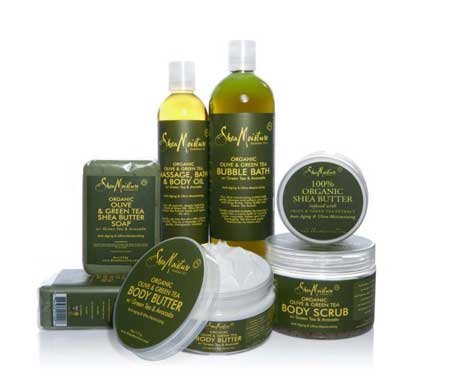
I know it's overwhelming. But thanks to growing education and demand among people, there are more and more products coming out without most of these harmful ingredients. My favorite product is Shea Moisture Olive Oil and Green Tea Lotion with Avocado. I splurged on it after a day in the sun and my skin was feeling sensitive and tight. It was the best decision I made. The entire Shea Moisture line is great and avoids many of these harmful toxins. You can find them at Walgreen's or Target or online. (image source)

If you made it all the way down here, thank you! I know it was long but I hope it was informative for you. If you did one thing to change your beauty routine to make it safer, you're making a huge difference already. It's one less harmful product being bought and one more good thing you can do for yourself. Between you and me, we can really help change the face of beauty care!